School notice:
Looking for a place at a GOOD school with OUTSTANDING features?
Call now to book a visit – 01902 947 830.
—
Looking to join our breakfast club? Register our interest here >>
Facilities available for hire – book now >>
School notice:
Looking for a place at a GOOD school with OUTSTANDING features?
Call now to book a visit – 01902 947 830.
—
Looking to join our breakfast club? Register our interest here >>
Facilities available for hire – book now >>

Our Music Development Plan

| Detail | Information |
| Academic year that this summary covers | 2026 – 2027 |
| Date this summary was published | September 2026 |
| Date this summary will be reviewed | July 2027 |
| Name of the school music lead | Sian Cook |
| Name of school leadership team member with responsibility for music (if different) | Sian Cook
Rhianneth Highfield |
| Name of local music hub | Black Country Music |
| Name of other music education organisation(s) (if partnership in place) | CBSO
Dudley Performing Arts |
This is a summary of how our school delivers music education to all our pupils across three areas – curriculum music, co-curricular provision and musical experiences – and what changes we are planning in future years. This information is to help pupils and parents or carers understand what our school offers and who we work with to support our pupils’ music education.
This is about what we teach in lesson time, how much time is spent teaching music and any music qualifications or awards that pupils can achieve.
Our school aims to provide an ambitious, rigorous and relevant music curriculum and inspires creativity and excellence in music. Pupils will foster a love of music by providing opportunities for pupils to engage with a wide range of historical periods, genres, styles and traditions, including the works of the great composers and musicians.
Our music curriculum both engages and connects to other learning through thematic study but is not limited to thematic study alone, ensuring that music education is delivered as a connected, yet at times, discrete entity through a Focus Day provision.
The E3L curriculum values music as one of the highest forms of creativity and provides opportunities for in depth, specialist teaching provision to equip pupils with the musical skills to become successful musicians. The curriculum has been informed by the model music curriculum.
Pupils in KS2 develop a better understanding of how to play the glockenspiel in Music. Through a range of activities, pupils improve their ability in recognising musical dimensions within music, for example pulse, rhythm, pitch and melody.
In EYFS, music is an integral part of the E3L themes covered during the year and as part of the specific area, Expressive Arts: Being Imaginative. We relate the skill aspects of musicianship to the objectives set out in the Early Learning Goals (ELGs). Music is also used effectively to contributes to a pupil’s personal and social development. Singing and basic rhythm skills are incorporated to support mathematical ability and to enrich knowledge and understanding of the world through cultural diversity.
We encourage pupils to learn to play a musical instrument by providing opportunities within and beyond the music curriculum to support pupils’ creativity and musical thinking. Through DPA, our children in Year 2 and Year 5 have whole-class weekly keyboard lessons. Children will begin to learn graphic notation in Year 2 with children in Year 5 focussing on formal notation.
Opportunities are provided for pupils to create and compose music, to sing and learn to use their voices, to explore how music is created, produced and communicated and to harness technology in the creation of music. Pupils are supported by organisations such as the CBSO and Dudley Performing Arts.
Pupils are excited by their learning in music and develop a sense of self-confidence through composition and performance. They will develop an appreciation for a wide range of music and are able to offer their opinions about different musical styles.
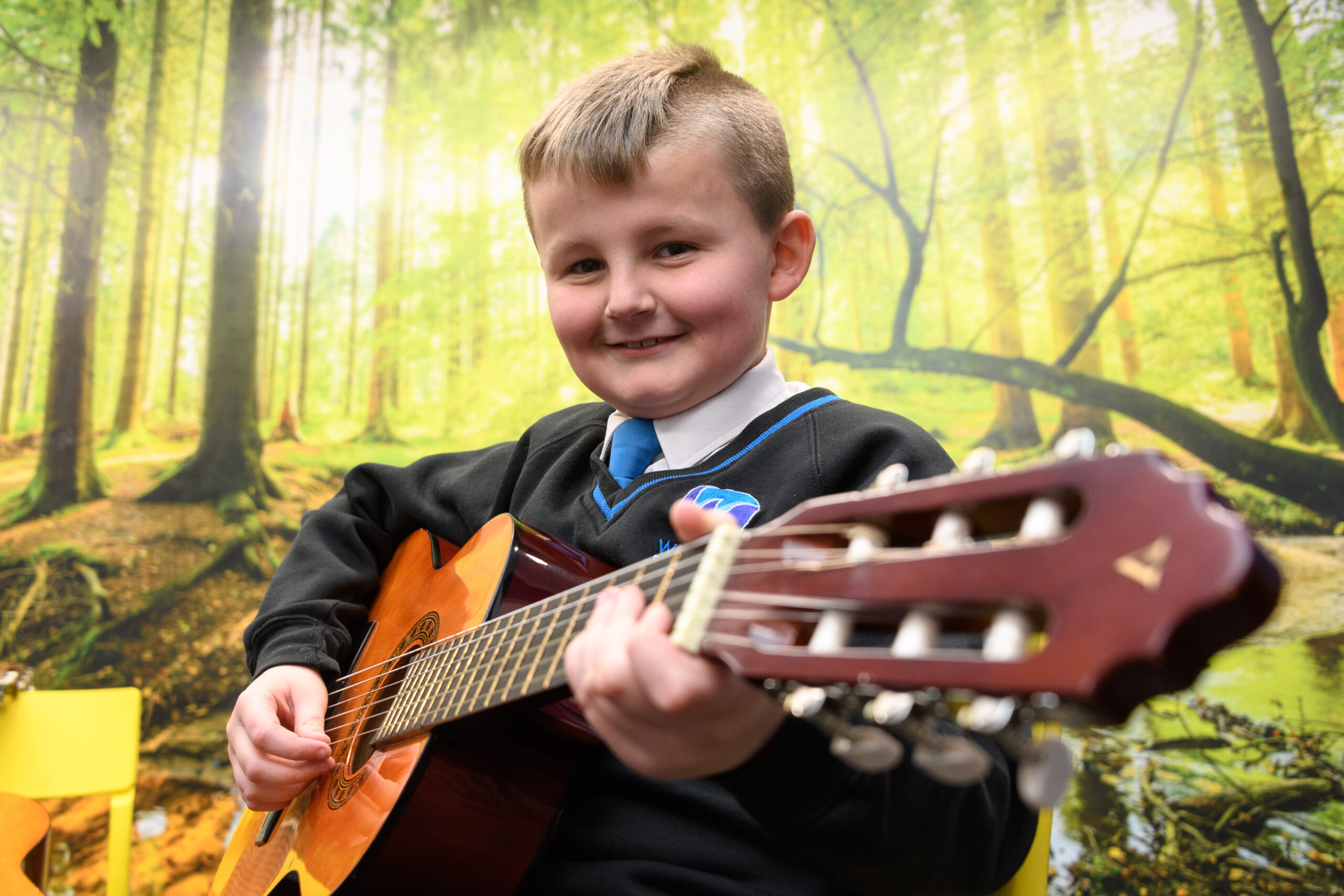
Pupils demonstrate a high level of creativity, musical skill, knowledge and understanding through the creation of high-quality outcomes, including performance. As part of the music provision, pupils in years 5 and 6 receive small group instrumental tuition provided by DPA, learning to play the guitar.
Pupils make connections in their learning, both within music and with learning from other subject areas, such as history. They use these connections to support their understanding of music genre, composition and performance as well as to support their understanding of society, culture and change over time.
Pupils have a sound understanding of musical concepts, dimensions, composition and broad range of musical skill. They use their musical understanding to create, compose, evaluate and communicate and perform music. Our curriculum aims to remove barriers to learning for pupils with SEND. With support, and curriculum adaptations, SEND pupils can express themselves and take an active part in musical sessions. Scaffolding techniques and a variety of responsive teaching strategies are adopted so that all pupils, including those with SEND can progress and flourish.
Their musical knowledge is developed through our use of key pieces of music which support all our E3L themes and are in both whole class and whole school situations.
This is about opportunities for pupils to sing and play music, outside of lesson time, including choirs, ensembles and bands, and how pupils can make progress in music beyond the core curriculum.
As part of the co-curricular music and linked to our core curriculum offer, our school has focus days which run from Year 1 to Year 6 which links to the E3L theme being taught. The day where the curriculum is collapsed, and music is taught by a music specialist. This supports the coverage of the MMC and deepens pupils understanding of the music curriculum. Our focus day provision is supported and delivered by a primary music specialist to deepen and enhance the pupils’ knowledge and skills of music.
Throughout the school there are other musical opportunities that are given to the pupils.
Pupils take part in choral activities that lead to performance including a Christmas carol concert that takes place at Christ Church in Coseley.
Every year, the whole-school take part in the Harmony singing event from Dudley Performing Arts. Our pupils join thousands of children across Dudley in marking Children’s Mental Health Week and they participate in a mass choir event. The idea behind this is the promotion of music as an aid for mental health and wellbeing. Pupils learn how music lifts their mood and promotes a sense of unity.
For those pupils who are considered gifted and talented, our school seeks help and support to further develop them from CBSO and DPA. This support has included opportunities to perform to their peers and parents, extra-curricular activities and funding if they are pupil premium.
This is about all the other musical events and opportunities that we organise, such as singing in assembly, concerts and shows, and trips to professional concerts.
Pupils are given many opportunities to have musical experiences including singing assemblies that take place on a fortnightly basis. In these sessions, both staff and pupils are encouraged to develop a love of singing and understand the mental wellbeing benefits to singing in a large group. Music taught through singing assemblies supports pupils’ personal development by fostering a shared sense of belonging while broadening their understanding of diversity through exposure to different cultures, musical artists, traditions and genres from around the world.
Pupils learn the importance of song and singing linked to different countries, cultures and religions. They discover the role of music in celebrations and festivals. The songs are carefully selected to represent music from different parts of the world, with their own unique styles, such as; British alternative rock, American pop, Reggae, traditional Christian carols, African folk music.
Music underpins a lot of the wellbeing and mental health work we deliver to our pupils and fosters social connection and inclusion by encouraging teamwork and cooperation. Group activities such as choir singing or ensemble playing create opportunities for pupils to bond, share experiences, and feel part of a community. This sense of belonging reduces isolation and promotes empathy among peers.
Using music during writing sessions can significantly enhance pupils’ wellbeing and mental health by creating a calm and focused environment. Gentle background music helps reduce anxiety and promotes relaxation, allowing children to concentrate without feeling pressured. It can stimulate creativity, improve mood, and encourage sustained engagement with the task, making writing feel less daunting. This supportive atmosphere fosters emotional security and resilience, enabling pupils to express themselves more freely and enjoy the process of writing, which contributes to their overall sense of wellbeing.
Beyond emotional and social benefits, music supports cognitive and physical development. It stimulates brain regions linked to memory and concentration, enhancing learning across subjects. Movement and dance activities associated with music improve coordination and gross motor skills, while also providing an enjoyable way to release tension.
Pupils participate in end of Key Stage performances. These include nativities at the end of EYFS and Key Stage 1, and musical performances and the end of Key Stage 2. Pupils participate in choral activities around Christmas including carol concerts and musical showcases. In these performances, pupils get a chance to experience performing to a larger audience and performing both individually and in groups.
In school, free concerts are shown. These are provided to our school by partnership providers including the CBSO and DPA music. Pupils also can perform in their own repertoire project that is supported and lead by musicians from the CBSO. Pupils can watch an orchestra perform and share and discuss the experience with a focus on musical appreciation.
Through of partnership with DPA, pupils are invited to attend Indian drumming and Bhangra dancing workshops. We partner with other schools in the Dudley Local Authority every year to participate in the Harmony event. This event is linked to Children’s Mental Health week and pupils join a live stream with other schools to sing together and reflect.
Through a partnership with the CBSO, our pupils are offered visits to watch performances given by the musical secondary school pupils. These visits inform and enhance the learning of music-driven E3L themes, including the Year 4 E3L theme, Musical Express and Year 6’s Mozart Mash Up.
This is about what the school is planning for subsequent years.
The following are where music will be further development in the subsequent years to follow:
Wallbrook Primary Academy is part of the Shireland Collegiate Academy Trust, which recognises the intrinsic value of music education and the enormous creative, personal, and academic benefits that engagement with music can develop. In particular, we acknowledge that all pupils regardless of background are entitled to a rigorous and rich Music education that inspires the next generation of musicians and music-lovers and exposes all to a wealth of cultural capital. We are committed to developing our provision across all primary and secondary phases in line with the latest curriculum guidance and with the support of specialist practitioners both within and without the trust.